
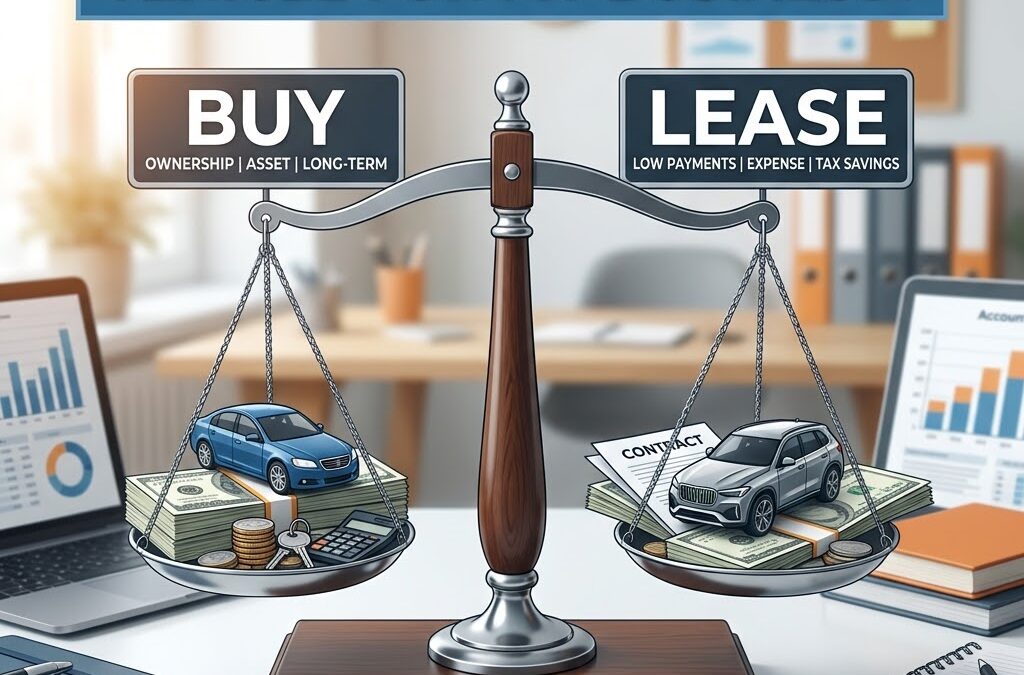
Should I Buy or Lease a Vehicle for my Business?
This is a question I have been getting a lot lately. Whether you’re a self-employed consultant, a small business owner, or managing corporate operations, acquiring a new vehicle always brings up the age-old question: Should you lease or buy?
While the lifestyle pros and cons are well-known—leasing gives you that new-car smell every three years, while buying means no mileage limits—the accounting and tax implications in Canada are vastly different. The Canada Revenue Agency (CRA) treats these two methods through entirely separate frameworks. This topic can get very complicated and this post is for general information only. I still advise talking to a professional to make sure you are aware of what accounting rules apply to you.
Let’s lift the hood on how the accounting works for both options so you can make the most tax-efficient decision for your business.
The Common Ground: What’s the Same?
This post discusses the acquisition of the vehicle themselves. However, some other factors are the same regardless.
- Operating Expenses: Whether you lease or buy, you can deduct the business-use percentage of running costs, including fuel, maintenance, insurance, and registration fees.
- The Business-Use Ratio: You can only deduct expenses proportional to your actual business driving. Keeping an accurate mileage log is mandatory.
Option 1: Accounting for a Purchased Vehicle
When you buy a vehicle (either with cash or through a traditional loan), you are purchasing an asset. From an accounting perspective, you cannot write off the entire purchase price in year one. Instead, you must capitalize the asset and write it off over time through Capital Cost Allowance (CCA) often called depreciation. The rate of depreciation is 15% in the first year and then 30% each year after.
Vehicles are categorized into specific tax classes based on their design and cost. For standard passenger vehicles, the most common classes are:
- Passenger Vehicles: A passenger vehicle is a standard vehicle that transports people. This can be a car, truck, van etc. A passenger vehicle has a ceiling in what can be depreciated. In 2026 that ceiling is $39,000, meaning any amounts paid above this price cannot be depreciated for tax purposes.
- Motor Vehicles: These are vehicles that are commonly used to carry not only people but also goods or equipment. An example would be vehicles you see with racks for tools or trucks that deliver construction equipment. These vehicles do not have a ceiling in what can be deducted.
Loan Interest
If you financed the purchase with an automotive loan, the principal portion of your monthly payment is not deductible (as it reduces your loan liability). However, the interest on the loan could be deductible.
Option 2: Accounting for a Leased Vehicle
When you lease a vehicle the monthly lease payment can be deducted against your business income. However, just like purchasing, the CRA imposes limits on lease write-offs depending if it’s a passenger vehicle or motor vehicle. The maximum allowable lease deduction is $1,100 per month (plus GST/HST) for a passenger vehicle and there is no maximum for a motor vehicle.
So, Which is Better, Buying or Leasing?
When you buy you get larger tax deductions in the early years, but this slowly declines as the vehicle ages.
For example if you buy a vehicle for $20k, your annual depreciation deduction is:
Year one $3,000 (deduct 15%)
Year two $5,100 (30%)
Year three $3,570
Year four $2,499
But if you bought that same vehicle and leased it (0% interest) the annual deduction would be level $4,000 annually. When you lease your tax deduction is evenly spread out.
The true benefit comes down to other factors to consider. If you’re business has stable cash flow leasing may be best. If you just came into a sum of cash (or interest rates offered are very low) buying could be better. In my experience often the retailer will offer incentives to make one option better. For example, several years ago a car dealer offered us an incredible warranty on leased vans that allowed us to be more productive and reduce our costs. Another time a dealer offered rock bottom prices on a quantity of pickup trucks with 0% financing.
Acquiring a vehicle is often a major decision for any business owner. It can lock you into a contract for several years and tie up cash flow. However, you proceed take your time and look at your options. If you have any questions do not hesitate to reach out.
Recent Comments